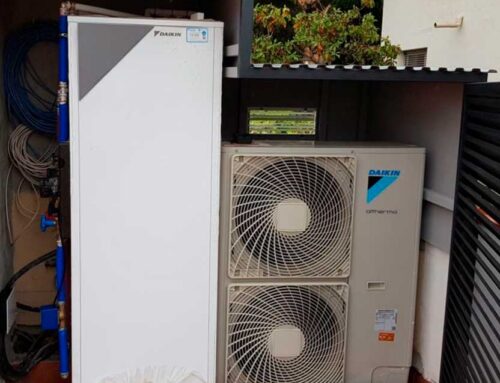
“How much does it really cost to put a heat pump in a Barcelona flat?” It is the question we hear most at the technical visit, and it almost always comes with another one: “and how much is left after the grants?”. In this guide we answer both with the figures we work with on our aerothermal installations in Barcelona: what the price includes, what pushes it up or down, how much you can recover with the 2026 grants and how many years it takes to pay for itself compared with a gas boiler.
Summary: indicative price of aerothermal in Barcelona in 2026
| Type of installation | Unit + installation | With grant (approx. −40%) |
|---|---|---|
| Flat or small home (up to 80 m²) | €6,000–9,000 | €3,600–6,300 |
| Medium-sized home (80–150 m²) | €9,000–14,000 | €5,400–9,800 |
| Large home or house (over 150 m²) | €14,000–22,000 | €8,400–15,400 |
| Replacing the boiler with a heat pump, keeping radiators or floor as they are | €5,000–8,000 | €3,000–5,600 |
Indicative prices including VAT for Barcelona and its metropolitan area. The fixed quote is prepared after the free technical visit, and grants depend on each call for applications.
What the price of an aerothermal installation includes
When comparing quotes it pays to look inside, because the difference between a €6,000 quote and a €9,000 one for the same home is usually in what one includes and the other does not. A complete JAG Alcaide installation includes:
- The air-to-water heat pump (outdoor unit plus indoor hydraulic module), from Mitsubishi Electric, Daikin or Bosch, sized according to floor area, insulation and number of bathrooms.
- The domestic hot water cylinder, normally 150 to 300 litres depending on how many people live in the home.
- Connection to the distribution system: radiators, underfloor heating or fan coils, with whatever valves, pumps and manifolds are needed.
- A dedicated electrical supply with its protection and, if necessary, an upgrade of the consumer unit.
- Commissioning, with heating-curve settings, user training and activation of the manufacturer’s warranty.
- The grant applications, which we handle.
The five factors that move the price
1. The output the home needs
A well-insulated 70 m² flat in the Eixample can run on a 5-6 kW unit; a 180 m² house in Sant Cugat with lots of glazing needs 11-16 kW. Output is the factor that weighs most in the price of the unit, which is why we distrust quotes given without seeing the home.
2. The heat distribution system
A heat pump works with water at 35-45 °C, much lower than a boiler’s 60-70 °C. With underfloor heating it performs at its best and nothing needs changing. With radiators it can work, but they have to be properly sized or some replaced with low-temperature models; we explain it in the guide a heat pump with existing radiators. Fan coils are the middle option and also provide cooling in summer.
3. Whether it replaces a boiler or is installed from scratch
Replacing a gas boiler with a heat pump using the existing water pipework is the cheapest option (€5,000-8,000). A new installation in a build or renovation, with underfloor heating included, is the most complete and the most expensive, but also the one that attracts the most grants.
4. Where the outdoor unit goes
In Barcelona this point decides many installations. Terrace, courtyard or communal roof with easy access: normal cost. Facade needing rope access, or a roof with no stair access: the access equipment has to be added. We cover it in detail in a heat pump in a Barcelona flat.
5. Brand and range
Between a basic and a top-of-the-range unit from the same manufacturer there can be a difference of €1,500-3,000. The top range gives better performance at low temperatures, more quietness and connectivity. In a Barcelona flat, with mild winters, the mid-range is usually the sensible choice.
How much you get back from grants in 2026
This is what changes the sums. In 2026 there are three routes that are compatible with each other, as long as the same cost is not funded twice:
- MOVES III programme / renewable energy grants: between 30% and 40% of the installation cost depending on the applicant’s profile.
- Barcelona Housing Consortium (Next Generation funds): up to €6,000 per main residence in Barcelona city for works that replace fossil fuels with renewables; the current call closes in June 2026.
- Income tax (IRPF) deduction of 40% (maximum base €7,500) if the works reduce non-renewable primary energy consumption by at least 30%, on the part paid out of your own pocket.
A real example: 90 m² flat in Gràcia, gas boiler replaced with a heat pump and hot water cylinder, €9,500 installation. Consortium grant: €3,800 (40%). IRPF deduction on the remaining €5,700: up to €2,280 the following year. Net cost: around €3,400. All the details and requirements are in boiler replacement grants in Barcelona.
What you save each year and when it pays for itself
An air-to-water heat pump in Barcelona delivers between 3.5 and 4.5 kWh of heat for every kWh of electricity it uses. A condensing boiler, around 1 kWh of heat per kWh of gas. In bill terms, for a flat spending €900-1,100 a year on gas for heating and hot water, a heat pump usually brings the energy cost down to €450-600, a saving of €400-600 a year; if you also have solar panels the saving is higher, because you produce part of the electricity yourself.
With those numbers, the extra cost of a heat pump compared with a new boiler (about €4,000-6,000 more before grants) pays for itself in 6-8 years without a grant and in 2-4 years with one. After that, it is all savings for the unit’s 15-20-year life. The full comparison is in natural gas vs air source heat pump in Barcelona.
When a heat pump is NOT worth it
We tell you at the visit if this is your case, because we would rather not install than install badly:
- If the home has small iron or aluminium radiators and you do not want to replace them or add emitters: on the coldest days it will not reach temperature.
- If there is nowhere reasonable for the outdoor unit (no terrace, no courtyard, no accessible roof, and the residents’ association does not allow the facade).
- If heating consumption is very low (a well-oriented studio that hardly turns the heating on): the annual saving does not justify the investment, and a condensing boiler or a heat-pump split does the job better.
- If you need it solved today because the boiler broke down in January: a properly done heat pump needs a study and 1-2 weeks’ lead time; in that case we install a boiler and plan the heat pump calmly, or look at a hybrid system.
Frequently asked questions about heat pump prices
Does the price include the hot water cylinder?
Yes, our quotes include the DHW cylinder, because without it the heat pump would only provide heating. Its size depends on how many people live in the home: 150-200 litres for 2-3 people, 250-300 for 4-5.
How much does heat pump maintenance cost?
Less than a boiler’s: there is no combustion and no flue. An annual service (cleaning the outdoor unit, checking refrigerant, pressures and filters) costs between €120 and €180, and there is no compulsory gas inspection.
Can it be financed?
Yes. We offer payment plans for larger installations and, when the grant is paid months after the work, we help organise the payment schedule around it.
How long does the installation take?
Replacing a boiler with a heat pump takes 1-2 days. With new underfloor heating or radiator replacement, the building work sets the timescale. Before that, the technical visit and fixed quote take 24-48 hours.
What if grants for gas boilers come back in a few years?
Since January 2025 European regulations exclude gas boilers from public subsidies, and the trend is the opposite: more restrictions on fossil fuels, not fewer. A heat pump is the option the regulations favour and the one that improves the home’s energy certificate.