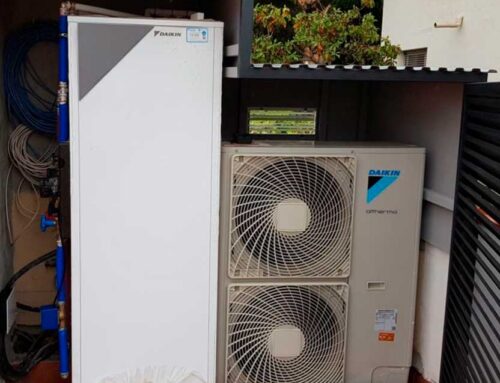
Most people in Barcelona live in a flat, and the first doubt about a heat pump is not the price but the space: where does the outdoor unit go? Will the residents’ association allow it? Does the hot water cylinder fit in a 75 m² flat? We have spent years answering these three questions in buildings in the Eixample, Gràcia, Sant Martí and Les Corts, and in this guide we explain how it is done, what the rules say and which solutions work when the building does not make it easy.
First things first: yes, you can install a heat pump in a flat
A domestic aerothermal system has two parts: an outdoor unit (similar to an air conditioner’s but somewhat larger: 90 to 140 cm wide and 60-100 kg) and an indoor module with the hot water cylinder, which takes up about as much room as a narrow fridge or hangs on the wall like a boiler if you choose a separate cylinder. If your flat has, or could have, an air conditioner with an outdoor unit, it can almost always have a heat pump.
Where to put the outdoor unit in a Barcelona flat
| Location | When it is feasible | What to bear in mind |
|---|---|---|
| Own terrace or balcony | The most common and cheapest option | Distance to the neighbour’s window, condensate drain, and that the noise (35-45 dB at 1 m) does not disturb |
| Light well | Very common in older buildings | Rope access, enough ventilation so the air does not recirculate, residents’ association permission |
| Communal roof | Technically ideal: open air and no neighbours in front | Authorisation from the residents’ meeting, pipe run through a service shaft or inner facade, distance limit to the indoor module (usually 30-50 m) |
| Outer facade | Only if the association allows it and the building is not listed | Barcelona’s urban landscape by-law: in many cases it must not be visible from the street |
At the technical visit we measure the pipe run, check the drain and look for the spot where the outdoor unit has air and disturbs least. Many Barcelona installations end up in the light well or on the roof, not on the facade.
The residents’ association: what you can do without permission and what you cannot
Installing the outdoor unit on your private terrace or balcony does not need the meeting’s approval, as long as the structure and the outward appearance of the building are not substantially altered and the by-laws are respected. Using communal elements (facade, roof, light well, service shafts for the pipes), on the other hand, requires the association’s authorisation. In practice:
- We check the by-laws before quoting: some buildings prohibit facade installations or set specific areas.
- We prepare a short report with photos, dimensions, the unit’s sound level and the pipe route for you to present to the property manager or the meeting. A clear document avoids most refusals.
- If the building is in Ciutat Vella or is listed, the unit must not be visible from the public street; the courtyard or roof is the solution.
- Noise is the neighbours’ most common objection: current Mitsubishi Electric, Daikin and Bosch units run in night mode below 40 dB, similar to a fridge, and we can always add anti-vibration mounts and acoustic screens.
The indoor module and cylinder: where they fit in a flat
The hydraulic module with an integrated 180-200-litre cylinder measures about 60 cm wide by 60 cm deep and 1.80-2 m high. The usual places in a flat are the gallery, the utility room, a tall kitchen cupboard or the old boiler’s spot if you opt for a wall-hung module with a separate cylinder. If there is no space, there are horizontal cylinders for high-level mounting and compact 150-litre modules. We work it out at the visit with a tape measure in hand.
Can I use the radiators I already have?
It depends on their size. A heat pump heats water to 35-45 °C and a boiler to 60-70 °C, so a radiator gives out less heat with a heat pump. In flats with properly sized aluminium radiators it usually works; in flats with small radiators one or two have to be replaced or a fan coil added. We have a specific guide: a heat pump with existing radiators.
What about air conditioning?
With fan coils or a cooling floor, the same heat pump provides cooling in summer. If you keep radiators, the unit will only provide heating and hot water, and air conditioning would still be a separate split. It is a decision to make before quoting, because it changes the type of unit and emitters.
Formalities we handle
- Report for the residents’ association and, if needed, phone support at the meeting.
- Application for grants (Barcelona Housing Consortium, MOVES III) and documentation for the IRPF deduction.
- Cancellation of the gas contract if the flat stops using it, and certification of the electrical installation.
- Removal of the old boiler and sealing of the flue.
Frequently asked questions
How much does a heat pump cost in a flat?
Between €6,000 and €9,000 for a flat of up to 80 m² and between €9,000 and €14,000 for a medium-sized one, before grants; with a grant, around 40% less. The breakdown is in the real cost of a heat pump in Barcelona.
Can the residents’ association stop me installing a heat pump?
It can refuse the use of communal elements (facade, roof) if the by-laws provide for it or the meeting decides so, but it cannot stop you installing it on your private terrace in compliance with noise and appearance rules. That is why we always look for a private location first.
Is it noisy inside the home?
The indoor module sounds like a modern boiler (a circulation pump); the outdoor unit is what makes the noise, and it is outside. In quiet mode it stays below 40 dB.
How long does installation take in a flat?
One or two days if the existing radiator pipework is used and the outdoor unit goes on a terrace or in a courtyard with access. If pipes have to be run up to the roof or rope access is needed, two or three days.
Is it worth it in a small flat?
If you spend more than €600-700 a year on gas, yes, especially with the current grants. If your consumption is very low, we will tell you at the visit and suggest the alternative that makes sense.