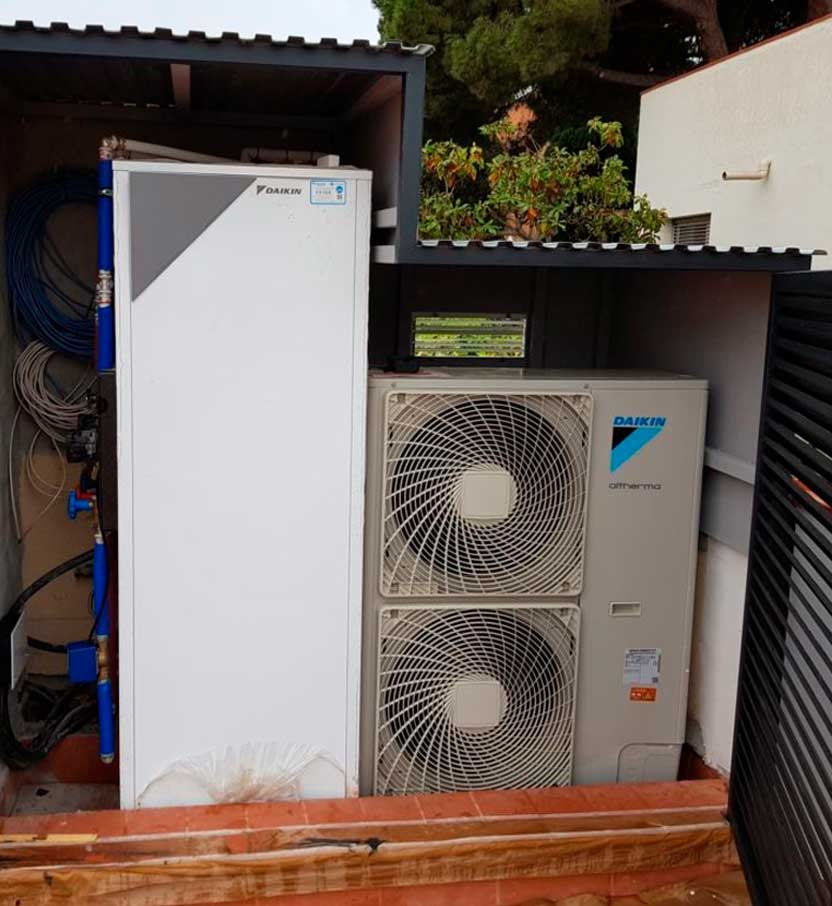
“I have radiators and I’ve been told a heat pump only works with underfloor heating.” We hear it every week, and it is not accurate. A heat pump works with radiators, but not with any radiator or at any temperature. This guide explains why, how to know whether yours are suitable, what the options are when they fall short, and what we do in each case in Barcelona.
Why water temperature changes everything
A gas boiler sends water to the radiators at 60-75 °C. An air-to-water heat pump can reach those temperatures, but its efficiency drops sharply: at 35 °C it delivers about 4 kWh of heat per kWh of electricity; at 55 °C, about 2.5-3; at 65 °C, little more than 2. In other words, the hotter we ask for the water, the less we save. That is why a well-designed heat pump works with water between 35 and 45 °C, and for a radiator to heat the room with water at that temperature it has to be larger than the one we would fit with a boiler.
How to know whether your radiators are suitable
The rule of thumb: a radiator sized for 70 °C gives out roughly half the heat at 45 °C. If your radiators were oversized when installed (common in flats renovated in the 2000s, when extra sections were added “to be safe”) or if the home’s insulation has improved since (new windows, enclosed gallery), they may well work as they are. We check it at the visit with three pieces of data:
- Area and insulation of each room: we calculate the real heat demand, not the theoretical one.
- Size and type of each radiator: aluminium, steel or cast iron; number of sections and height.
- How you use the heating: a home that runs the heating continuously at 20 °C needs a lower water temperature than one that switches it on for two hours at night and wants instant heat.
With that data we tell you, radiator by radiator, which are suitable and which are not. In our experience in Barcelona, with mild winters, in most flats all or almost all of them are.
The options when the radiators fall short
| Option | What it involves | When we recommend it |
|---|---|---|
| Replace 1-3 radiators with larger ones | No building work; the same connections are used | When only the living room or a large bedroom falls short |
| Low-temperature radiators | Models designed for 45 °C, slightly larger or with a built-in fan | Partial renovation or flats with old iron radiators |
| Fan coils in the main rooms | Units similar to a split that provide heating and cooling from the same heat pump | When you also want air conditioning |
| High-temperature heat pump | Units that deliver water at 65-70 °C | Large houses with iron radiators that are not to be touched; lower savings |
| Hybrid system (heat pump + boiler) | The boiler only kicks in on the coldest days | When there is already a recent boiler and borderline radiators |
How we install with radiators
- Heat-load study room by room and a check of each radiator at the design temperature (usually 45 °C).
- Circuit cleaning: old radiator circuits carry sludge that reduces flow; we flush the system and add a magnetic filter and inhibitor, essential for the heat pump’s warranty.
- Hydraulic balancing: we adjust the flow to each radiator so they all heat evenly at low temperature.
- Buffer tank if the circuit is small, so the unit does not keep starting and stopping.
- Heating curve: we programme the unit to raise the water temperature only when it is colder outside and lower it the rest of the time. This is what determines the real saving.
- Thermostat and wifi control so you can see consumption and adjust schedules.
How much you save with a heat pump and radiators
With properly sized radiators and water at 40-45 °C, a heat pump in Barcelona delivers about 3-3.5 kWh of heat per kWh of electricity, compared with 4-4.5 for underfloor heating. It is still two to three times more efficient than a condensing boiler: for a flat with €900-1,100 a year in gas, the energy cost drops to about €500-650. If the water has to be forced to 60 °C because the radiators are small, the saving halves and the investment stops making sense: that is why we are straight with you at the visit.
Frequently asked questions
Are cast-iron radiators suitable?
They are usually large with plenty of thermal mass, and often work well at low temperature. The problem is the dirt built up in the circuit: it has to be thoroughly cleaned before connecting the heat pump.
Will it take longer to heat the house?
Yes, if you switch it on from cold. A heat pump is designed to hold a steady temperature for many hours, not to heat up quickly. Changing the habit of “two hours on” to “keep it at 19-20 °C” is what makes it save.
Can I keep the boiler as a back-up?
Yes, that is the hybrid system. It makes sense if the boiler is recent; if it is more than 10-12 years old, it pays to remove it and size the heat pump properly.
Are there grants if I keep the radiators?
Yes. The grants (MOVES III, Barcelona Housing Consortium, IRPF deduction) are tied to the heat pump, not to the type of emitter. We explain them in boiler replacement grants.
How much does it cost?
Replacing the boiler with a heat pump while keeping the radiators costs between €5,000 and €8,000 before grants; each radiator that has to be changed adds €250-500. More detail in the real cost of a heat pump in Barcelona.